
Custom shipping boxes wholesale are made-to-measure corrugated cartons that protect products in transit and carry your branding to the customer’s door. Ordering them in bulk, cut to your exact product size, lowers damage rates and shipping costs. This guide covers board grades, box styles, printing, sizing, lead times and what to ask before you place an order.
What Are Custom Shipping Boxes and Why Order Wholesale?
Custom shipping boxes are cartons built to your product’s dimensions and weight instead of a stock size. Wholesale ordering spreads the production cost over a larger run, so each box costs less and your parcels look consistent from the first order to the last.
For most e-commerce brands and fulfillment teams, the gains are practical:
- Less void fill, because the box fits the product
- Fewer crushed or punctured parcels
- Faster packing, since every order uses the same structure
- A branded unboxing moment on every shipment
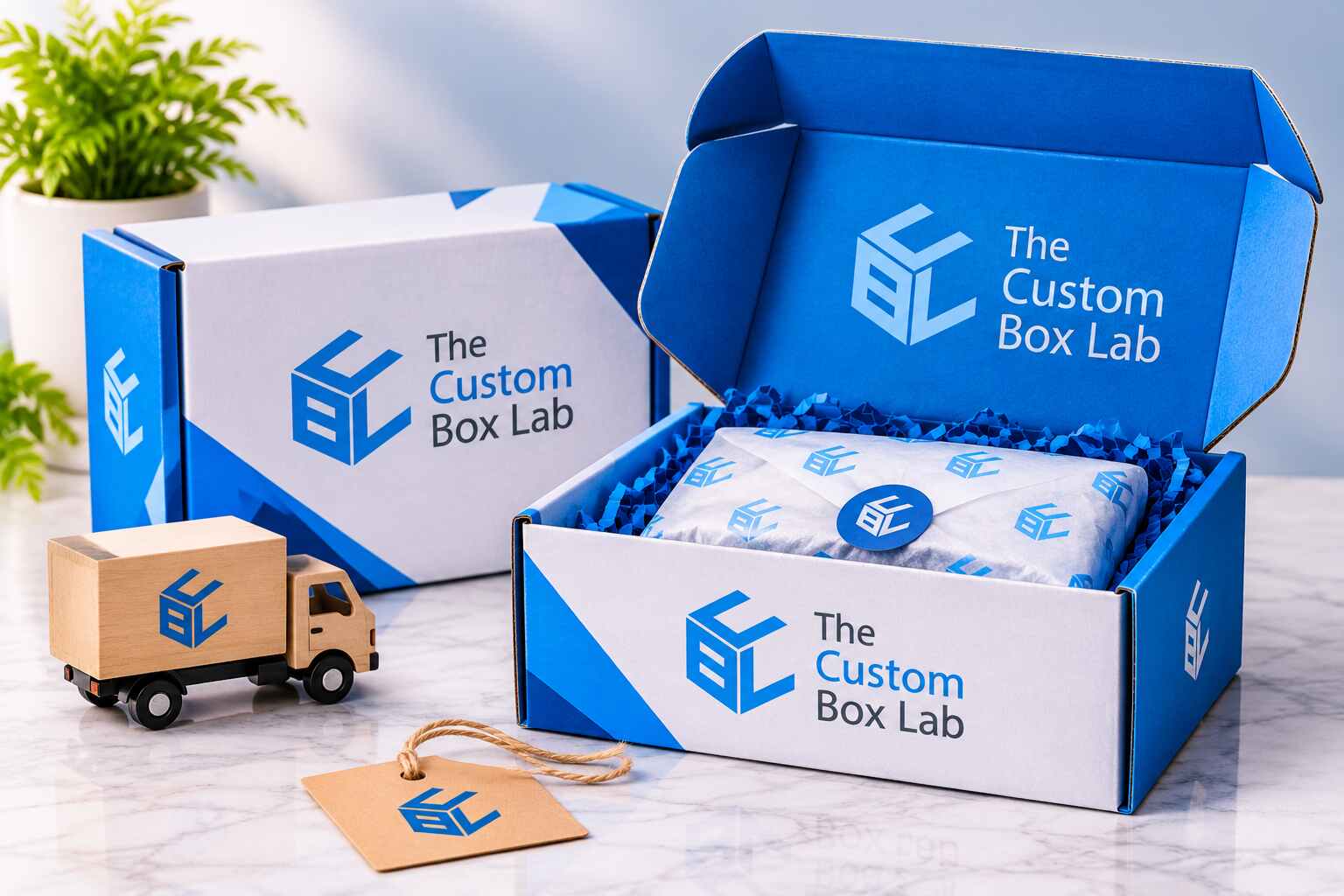
The Custom Box Lab makes corrugated shipping boxes in double- and triple-wall constructions, sized to your product with no die or plate charges.
Which Corrugated Board Grade Does Your Product Need?
The right board grade depends mostly on product weight and fragility. A box that is too light fails in the truck, and one that is too heavy adds cost you did not need.
| Board Grade | Best Suited For | Crush Resistance |
|---|---|---|
| Single wall, E-flute (about 1.5 mm) | Apparel, cosmetics and accessories under 5 lbs | Moderate |
| Single wall, B-flute (about 3 mm) | Supplements, small electronics, 5 to 15 lbs | Good |
| Double wall, BC-flute (about 6 mm) | Glassware, liquids, multi-item kits, 15 to 40 lbs | High |
| Triple wall (about 12 mm) | Industrial parts, fragile instruments, 40+ lbs | Maximum |
When Is Double Wall Corrugated Worth It?
Double wall has two fluted layers between the liners. That adds stacking strength and puncture resistance without adding much weight. Choose it for items over 15 lbs, for glass and liquids, or for parcels that pass through several carrier hubs before delivery. If you track damage claims, this is usually the grade where they start to drop.
Which Shipping Box Style Fits Your Fulfillment Setup?
The best style is the one that matches how your team packs, seals and ships. The wrong choice costs more in tape, labor and replacements than the box itself.
| Style | How It Works | Best For |
|---|---|---|
| RSC (regular slotted container) | Four flaps of equal length, outer flaps meet in the middle | High-volume fulfillment, speed and economy |
| Mailer box | Self-locking walls and tabs, no tape needed | Subscription and direct-to-consumer brands |
| Full overlap container (FOC) | Top and bottom flaps fully overlap | Heavy or high-value items through multiple sorting hubs |
| Half slotted container (HSC) | RSC without top flaps | Two-piece gift sets, bulk storage with quick access |
| One-panel folder or book mailer | One panel wraps the product with reinforced edges | Books, prints and flat rigid items |
Mailer Box or RSC: Which One Should You Pick?
Choose an RSC if you pack thousands of orders a week and every second counts. It ships flat, stores compactly and seals fast. Choose a mailer when presentation matters, because it opens cleanly and looks good on camera. Many brands use RSCs for bulk fulfillment and mailers for gift or subscription orders.
What Printing and Finishing Options Work on Shipping Boxes?
Digital, offset, flexographic and screen printing can all be applied to shipping cartons, and each suits a different order size. A logo on the outer box works as a moving billboard from the warehouse to the doorstep.
| Printing Method | Best For | Color Accuracy |
|---|---|---|
| Digital | Short runs, brands with several SKUs | High (CMYK) |
| Offset | Large runs, brand-critical colors | Highest (PMS match) |
| Flexographic | High-volume corrugated runs | Good |
| Screen printing | Bold single-color designs | Moderate |
Finishing options include gloss and matte lamination, soft-touch coating, foil stamping, embossing, debossing and spot UV. For shipping, matte or soft-touch finishes usually hold up better against scuffing than high gloss.
Is Branded Shipping Packaging Worth the Investment?
For most online brands, yes. The outer box is the first thing a customer touches, and a printed logo turns a plain parcel into part of the experience. Digital printing keeps short runs affordable, which lets smaller brands test a design before scaling.
How Do You Size Shipping Boxes to Lower Costs?
Add 1 to 2 inches on each side of your product to leave room for padding, then order to that exact size. A snug box reduces void fill, material waste and the dimensional weight charges that carriers apply. UPS, FedEx and USPS all price larger packages by volume as well as by weight, so oversized boxes can cost more than the product justifies.
Follow these steps:
- Measure your product’s length, width and height in inches.
- Add 1 to 2 inches per side for cushioning.
- Weigh the packed product to choose the board grade.
- Check the carrier’s dimensional weight rules for your typical destinations.
- Approve the 3D mockup before production starts.
Because every box is made to order, you are not limited to standard sizes. Small cubes, long slim cartons and oversized shapes are all possible.
What Products Can Go in Specialty Shipping Boxes?
Nearly any product can ship safely if the structure is built around it. The Custom Box Lab’s shipping range includes boxes for:
- Hats
- Flowers
- Paintings and framed art
- Mason jars
- Vials
- Hemp products
- Long, slim items
- Folding cartons and paperboard cartons
- Self-seal boxes
- Black and pink shipping boxes for branded presentation
Why Do Fragile Items Need Their Own Structure?
Fragile products fail in specific ways. A painting needs flat, rigid protection for its corners. Glass jars and vials need separation so they do not touch each other. Flowers need airflow and upright support. A generic box handles none of these well, which is why product-specific cartons reduce breakage.
How Long Does Production Take and How Does Ordering Work?
Production runs on three tracks, and your account manager confirms the right one when you request a quote.
| Track | Production Time | Best For |
|---|---|---|
| Express | 7 to 10 days | Launches, restocks, seasonal rushes |
| Standard | 12 to 15 days | Planned reorders |
| Cost Saver | 40 to 45 days | Large orders where budget matters most |
Ordering is straightforward:
- Send your product dimensions, weight and quantity.
- Choose the board grade, style and print method.
- Review the free 3D digital mockup.
- Confirm the order and approve artwork.
- Production starts and the order ships to you.
If you are ready to price a project, you can request a quote with your specs and get guidance from the team.
Are There Hidden Costs With Wholesale Shipping Boxes?
Always ask about tooling, design, minimums and freight before comparing quotes, because these charges change the real cost of an order. With The Custom Box Lab, die and plate charges are not applied, there is no minimum order quantity, design support is free, 3D mockups are free and shipping within the USA is free.
The no-minimum policy matters most for first-time buyers. You can order one size, check print quality and structural performance, then scale into larger or multi-SKU runs.
What Sustainable Shipping Options Are Available?
Recycled and kraft corrugated, paper-based cushioning and water-based coatings let you reduce plastic without hurting protection. Options include:
- Water-activated paper tape instead of plastic tape, so the whole parcel can go into one recycling stream
- Paper pulp or molded fiber inserts in place of polystyrene foam
- Soy and vegetable-based inks and water-based coatings
- Kraft and recycled corrugated liners across all board grades
If you plan to print “recyclable” on the box, review the FTC Green Guides first. They explain how to make environmental claims accurately.
How Do You Choose a Reliable Shipping Box Supplier?
A reliable supplier gives you a mockup before production, a named contact, clear pricing and honest lead times. Before you commit, ask:
- Will I see a 3D mockup before anything is printed?
- Is there a named account manager?
- Are die, plate and design fees included?
- Is there a minimum order?
- Which production track fits my deadline?
- What does shipping to my fulfillment center cost?
Frequently Asked Questions
What is the difference between single wall and double wall corrugated shipping boxes?
Single wall has one fluted layer between two liners, while double wall has two. Double wall gives higher stacking strength and puncture resistance, so it suits items over 15 lbs and parcels that pass through several carrier hubs.
Can I order custom shipping boxes with no minimum?
Yes. The Custom Box Lab does not enforce a minimum order quantity, so you can place a small test order before moving to wholesale volumes.
How long does production take for custom shipping boxes wholesale orders?
Express takes 7 to 10 days, Standard takes 12 to 15 days and Cost Saver takes 40 to 45 days. Your account manager confirms the track when you request a quote.
How do I order custom shipping boxes wholesale in the USA?
Send your product size, weight, quantity and print needs through the quote form or by phone. Review the free 3D mockup, approve it and production begins.
How much do custom shipping boxes cost?
Price depends on size, board grade, style, print method, finish and quantity. Larger runs lower the cost per box, so request a quote with your exact specifications for a firm figure.
Are custom shipping boxes made to exact product dimensions?
Yes. Every box is made to order, so you are not limited to standard sizes. A general rule is to add 1 to 2 inches on all sides for padding.
Does shipping cost extra?
Free shipping within the USA is included with The Custom Box Lab’s shipping box orders. Confirm the terms on your final quote.
Can shipping boxes be printed with my logo?
Yes. Digital, offset, flexographic and screen printing are available, along with finishes like matte lamination, soft-touch coating, foil stamping and spot UV.
Conclusion
Strong shipping packaging protects the product, controls shipping costs and makes a good first impression. Start with your product’s weight and fragility, choose a board grade and style that match, then size the box tightly to avoid extra freight charges. Order a small test run first if you are trying a new structure.