


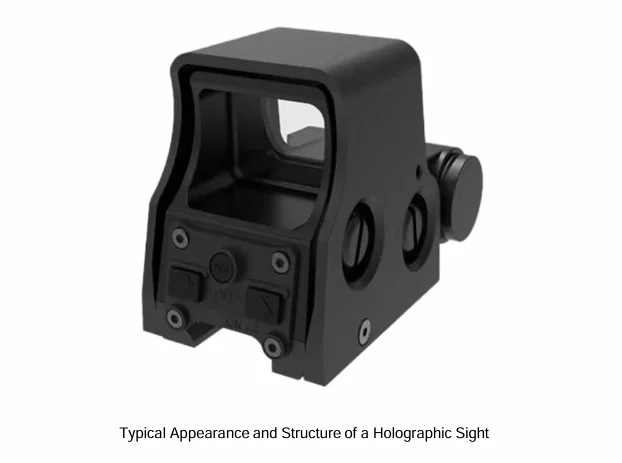

Optical technology continues to advance as manufacturers develop new ways to improve visual clarity, compactness, durability, and precision. Among the most interesting developments is holographic imaging, which combines laser technology, optical diffraction, and specialized reticles to create an advanced viewing experience. For organizations exploring modern optical solutions, understanding how these systems work can provide valuable insight into the future of precision optics.
A Holographic sight is built around a fundamentally different imaging approach from conventional mechanical sights and traditional red-dot systems. Instead of simply reflecting an illuminated point toward the viewer, holographic technology uses a holographic film and laser-based diffraction to produce a virtual reticle image perceived at optical infinity. This approach represents an important advancement in optical engineering.
At the heart of the system is a carefully engineered optical pathway. A laser diode provides a coherent light source, while a collimating mirror helps transform the beam into parallel light. The light then interacts with a holographic grating, directing the appropriate optical information toward the holographic reticle. The resulting image can be perceived by the viewer as a virtual aiming reference.
This combination of optical components demonstrates why precision manufacturing is essential. Laser stability, grating quality, optical alignment, reticle construction, and electronic controls all contribute to the overall performance of a holographic optical system. Even seemingly small variations in manufacturing can influence consistency and reliability.
Modern holographic systems can also incorporate electronic features designed to improve usability. Depending on the configuration, systems may include adjustable brightness settings, battery monitoring, automatic or shake-activated functions, and other control features. These additions demonstrate how optical engineering and electronics are increasingly integrated into a single compact product.
Environmental performance is another important consideration for professional optical equipment. Contemporary designs can be engineered to operate across a broad range of temperatures and withstand demanding physical conditions. Protective construction and appropriate sealing can further support reliable operation in challenging environments.
Manufacturing expertise plays a major role in bringing these technologies together. Shanghai VisYu Optical Technology Co., Ltd. combines optical research, product development, and manufacturing capabilities to support specialized optical solutions. Its expertise extends across optical system design, optical structures, optical films, and other advanced optical technologies.
The company also emphasizes proprietary optical materials and specialized components. Its holographic technology incorporates optical elements such as holographic gratings, reticle plates, collimating mirrors, and laser components. This broader component knowledge can be valuable when developing customized optical solutions for specific technical requirements.
Another notable aspect of modern holographic technology is its potential for customization. Optical manufacturers can work with different specifications involving dimensions, brightness, optical configurations, materials, and other design considerations. This flexibility allows businesses to investigate solutions that are better aligned with their particular applications.
For organizations researching advanced optical products, a Holographic sight offers an interesting example of how traditional viewing concepts can be transformed through modern optical science. Laser diffraction, holographic imaging, precision components, and electronic controls can work together to create sophisticated optical systems.
As demand for compact and high-performance optical technologies continues to develop, innovation in holographic imaging is likely to remain an important area of optical engineering. Companies with experience in both research and manufacturing can help turn advanced optical concepts into practical products, supporting the continued evolution of precision viewing technology.