



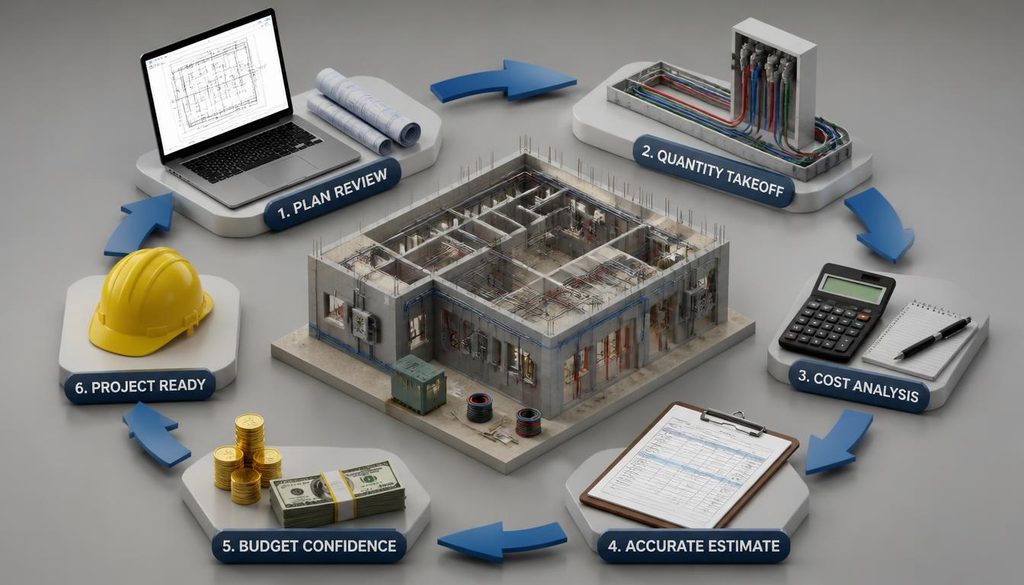
Electrical estimating services assist contractors in establishing a better starting point of origin before the workers order the required materials. By translating blueprints into accurate takeoffs, estimators determine the quantities of items such as conduits, wiring, switchgear, and lighting.
Where Do Electrical Estimating Services Begin?
It starts with the project documents. Estimators review the following:
- Floor plans
- Electrical layouts
- Equipment schedules
- Lighting plans
- Panel schedules
- Written specifications.
The goal is to identify every measurable requirement before pricing begins. This review can expose missing details, conflicting information, or scope items that require clarification.
Estimators then create a quantity takeoff for conductors, raceways, devices, fixtures, panels, equipment, and other components. Each quantity can receive a material rate, labor allowance, and applicable installation cost.
At Universe Estimating, estimators review drawings, specifications, schedules, and scope details. This is then used to convert electrical requirements into measurable quantities and projected costs.
What Does the Estimate Need to Account For?
Electrical work involves more than wires and fixtures. Different components create different purchasing, installation, labor, and coordination requirements.
| Estimate Area | Typical Items Reviewed | Why It Matters |
| Power | Panels, feeders, branch circuits | Establishes material and installation quantities |
| Lighting | Fixtures, controls, emergency units | Connects fixture counts with wiring requirements |
| Distribution | Switchgear, transformers, panels | Captures major equipment costs |
| Low voltage | Data, communications, security | Separates specialty systems from power work |
| Labor | Installation hours and crew requirements | Converts quantities into projected installation cost |
This breakdown helps contractors see where money is allocated instead of relying on one broad electrical allowance.
How Do Material Quantities Become a Budget?
Quantities need prices. Estimators apply current or project-specific rates to measured materials, equipment, and labor.
Electrical cost estimating can also separate direct costs from allowances, subcontracted work, equipment, and other project expenses. This separation simplifies the assessment of the estimate when there is a fluctuation in prices or the amount of work.
Example
Assume an imagined project that needs 2,000 feet of conductor for $1.80 per foot. The allowance for conductor will amount to $3,600.
If the labor to install it is estimated at $2,400, the total allowance for labor and conductor equals $6,000. The example does not take into consideration raceways, instruments, and equipment.
Why Does Scope Review Matter Before Pricing?
Small scope gaps can create large budget differences. A missing feeder, equipment connection, or control requirement can change both material quantities and installation hours.
Estimators compare drawings with specifications and equipment schedules to reduce these gaps. They can also document exclusions when the available information does not define an item clearly.
This process supports budget accuracy by connecting each priced item with identifiable project information. Clear assumptions also make later revisions easier to trace.
How Can Contractors Test Cost Changes?
Budgets change when designs change. A revised panel schedule, fixture selection, feeder route, or equipment load can affect several estimate lines.
Preconstruction planning allows contractors to examine these changes before field installation begins. Estimators can update quantities, compare alternatives, and identify cost-sensitive components.
The GAO guidance for cost estimating suggests the use of sensitivity analysis. This will help in evaluating the impact of changes in key cost drivers on the estimate.
For electrical work, this approach can help identify whether material quantities, labor requirements, or equipment selections have the greatest budget effect.
What Makes Electrical Budgets More Defensible?
Documentation matters. A useful estimate should show quantities, unit prices, labor assumptions, exclusions, and the documents used for measurement.
Electrical estimating services can arrange those in a documented cost history rather than just giving a final number, which enables contractors to analyze the bids better and talk about the scope.
Labor deserves careful attention as well. Project labor costs may significantly differ depending on location, worker type, productivity, overtime, and contract stipulations.
How Do These Systems Affect Early Budget Decisions?
Electrical systems often connect with architectural, mechanical, structural, and equipment requirements. A change in one trade can therefore affect electrical quantities or installation conditions.
A reliable estimate should account for these interfaces before construction starts. Contractors can then identify uncertain scope, compare pricing assumptions, and revise the budget as better information becomes available.
Conclusion
Electrical estimating services help contractors build fully documented budgets based on accurate material takeoffs and project scope. Estimators calculate precise quantities, outline labor requirements, and factor in current material pricing up front. Examining all these factors early provides the team with enough time to identify any gaps in the project scope before starting construction.