


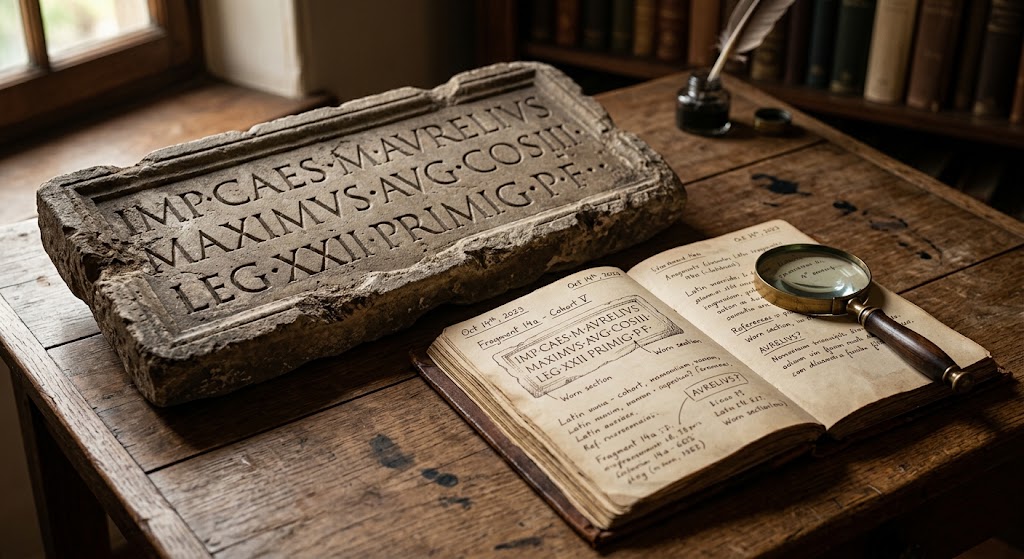

Picture this. You’re sat with a source in front of you maybe an inscription, maybe a page of Tacitus and it describes a political crisis, a battle won, a ruler doing something dramatic. You understand what it says. So the natural instinct is to explain what it tells you and move on. But the harder, more interesting question is the one most students skip: how do you actually know the source should be read that way at all?
That question is really the whole point of advanced ancient history. A Roman inscription might praise an emperor to the skies, but praise isn’t proof that the empire loved him. Herodotus gives you a rich, detailed account of events, but detail isn’t the same as an untouched record of what happened. And archaeology can quietly complicate a literary story without ever disproving it outright.
Once that distinction clicks, the whole purpose of source analysis shifts. You stop hunting for the one source that hands you “the truth” and start working out what each piece of evidence can reasonably support, where it runs out of road, and how historians have built rival interpretations from the same scraps.
Why This Matters More at Degree Level
For BA History and Classics students, particularly in second and third year, this is the point where ancient history stops being about knowing the timeline and starts being about analysis. Knowing what happened and being able to say what an ancient author wrote are useful foundations but on their own, they rarely carry a higher-level essay.
Primary evidence turns up in wildly different shapes. Literary texts give you narratives, speeches, character sketches. Inscriptions carry public messages, honours, laws, official claims chiselled in stone for a reason. Coins hint at political imagery and how a ruler wanted to be seen. Archaeology, meanwhile, can reveal patterns in settlement, trade, or religious life that no writer ever bothered to record.
None of these sources comes with a helpful label explaining what it proves. What it’s worth depends entirely on the question you’re asking of it.
Take an inscription celebrating an emperor’s military victories. That’s strong evidence those achievements were being publicly broadcast, and that certain ideas about imperial power were considered worth carving into stone. It’s much weaker evidence for what the average person on the street actually believed. That gap sounds small on paper, but it can be the difference between a solid essay and a shaky one.
Where Students Usually Go Wrong
The first trap is taking an ancient writer too literally. You’ll often see “Tacitus tells us that…” followed by a flat statement of fact, as if Tacitus were simply reporting the news. He wasn’t. He had a perspective, an agenda, an audience he was writing for none of which makes his account worthless, but all of which shapes what kind of evidence it actually is.
The second trap runs the opposite way. Once students cotton on to bias, it’s tempting to write off every source as unreliable and move on. That’s just as lazy. If an author keeps painting a certain type of ruler as dangerous or corrupt, that repeated pattern might say something genuinely useful about political attitudes at the time, or about the literary conventions the author was working within.
There’s also a mix-up that catches a lot of people out: using historians versus actually doing historiography. Writing “Scholar A argues X, Scholar B argues Y” is basically just reporting it’s a summary dressed up as analysis. The real historiographical work starts when you ask why they disagree. Different evidence? A different reading of the same passage? Different assumptions about how power or society actually worked?
If your essay work in this area could use a second pair of eyes, it’s worth having a look at what Ancient History Coursework Help UK offers not because it hands you a finished answer, but because seeing how a well-built argument moves from evidence to interpretation is genuinely one of the fastest ways to learn the skill yourself. Reading someone else’s reasoning, and picking apart where you’d push back, teaches you more than another lecture on source criticism ever will.
The Questions Worth Actually Asking
Source criticism isn’t a checklist you tick off author, date, purpose, done. Each question should genuinely change how you read the evidence. Who made this? Who was it meant to reach? What was it trying to achieve, and what circumstances shaped both its creation and its survival to today?
Purpose matters enormously here. A public inscription praising a ruler carries a different evidential weight than a private letter never meant for public eyes. A historian building a narrative of imperial politics is doing something different again not more or less useful, just different, and it pays to know which is which.
Context then gives all of that meaning. A statement about citizenship or warfare rarely stands apart from the political mood surrounding it. But context should sharpen your reading, not become an excuse to invent motives the evidence never actually gives you.
Keeping Your Claims Honest
The single most useful habit in this kind of essay is keeping your claim exactly as big as your evidence allows no bigger. If an inscription shows how an emperor wanted to be seen, don’t let that quietly slide into “the population accepted this image of him.” The gap between those two sentences might only be a few words on the page, but analytically it’s enormous, and examiners notice it every time.
Say you’re writing about how Roman emperors communicated authority. A coin bearing a particular symbol tells you something about political imagery. Compare that against an inscription or a literary account describing the same period. If the messages line up, that’s corroboration worth flagging. If they don’t, you’ve found a genuine question to dig into rather than a mess to quietly paper over.
The same care applies to modern scholarship. Rather than asking which historian is “right,” trace the route each one takes from evidence to conclusion. What are they prioritising? What alternative are they quietly rejecting? Is the disagreement really about the evidence itself, or about how much weight to give it?
Bringing It Together
Ancient history asks you to reconstruct a picture from evidence that’s incomplete, uneven, and often contradictory. A text gives you one fragment. An inscription gives another. Archaeology might fill a gap or open up an entirely new question nobody saw coming. That uncertainty isn’t something to hide in your essay; it’s genuinely what makes the subject worth studying.
Before you submit anything, go back through it claim by claim and ask yourself three things: what’s my evidence, what does it actually support, and what assumption am I quietly making to bridge the two? If you can answer all three honestly, you’re not just describing the ancient world you’re showing your reader exactly how a historical argument gets built, and why it holds up.