


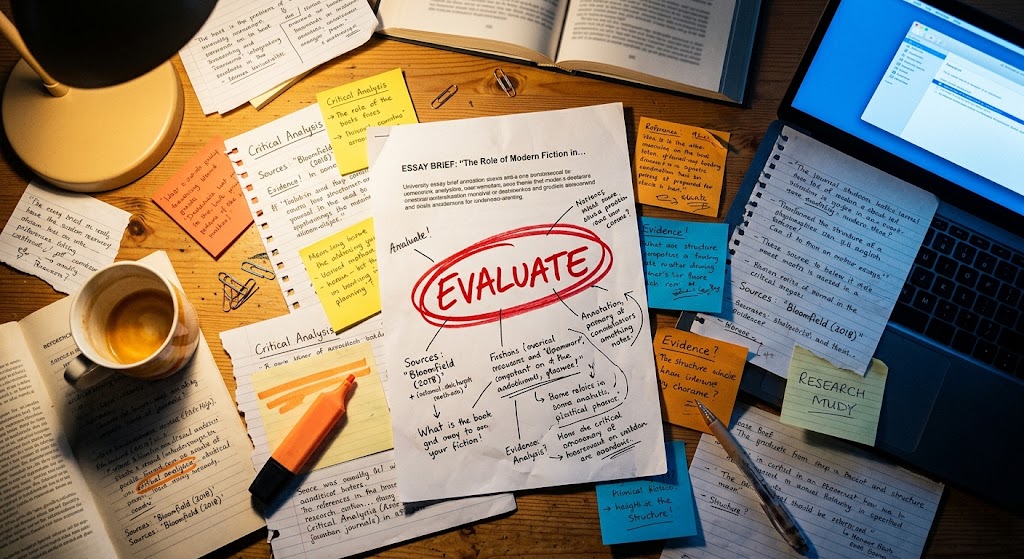

You’ve read the brief twice. Maybe three times. And you still don’t quite know what your lecturer wants from you. If that sounds familiar, you’re not alone, and you’re definitely not missing something obvious.
Words like “critically evaluate,” “analyse” and “assess” look simple sitting on a page. The trouble starts when you try to turn them into three thousand words of coherent argument. That gap between understanding a word and knowing what to do with it is where most of the stress at Level 5 and 6 actually comes from.
Here’s a better way to read a brief: don’t treat it as a checklist of topics to mention. Treat it as an instruction for how to think. Knowing your material still matters, obviously. But by this stage, your tutors also want to see you questioning it, testing it against evidence, and being honest about how far that evidence actually stretches.
What’s Actually Changing at This Level
Level 5 usually lines up with second year, Level 6 with your final year. Every university phrases things slightly differently, so always let your own module handbook have the final word over anything you read online, including this.
What genuinely shifts isn’t the difficulty of the theory itself. It’s your relationship to it. First-year work often rewards you for showing you understood the material. Later on, understanding is just the entry fee the marks live in what you do next.
Take a question like: “Evaluate the effectiveness of transformational leadership in improving employee performance.” A well-revised student can define the theory, list its traits, cite a few studies, and still miss the mark entirely, because “evaluate” is still sat there, unanswered.
Does the evidence hold up consistently? Does context change the outcome? Could something else explain the result? Those are the questions that turn revision notes into an actual argument.
The Warning Sign Nobody Talks About
Here’s a strange but common problem: your essay keeps growing, but it isn’t getting any clearer. That’s usually a sign research has become a collecting habit rather than an answering one. One article leads to another, a theory you hadn’t planned for creeps in, and suddenly you’ve got six pages that were never organised around the actual question.
Picture an essay on employee motivation. You could explain three motivation theories brilliantly and still fail the brief if the real question was about why motivation differs between remote and office staff. The theories aren’t wrong they’re just not doing the job you needed them to do.
Then there’s “critical,” which trips up almost everyone at some point. Some students think it means disagreeing with everything. Others get so nervous about it they just list five viewpoints and never actually judge any of them. Neither is what’s being asked. Critical thinking means asking what the evidence can genuinely support, not performing scepticism for its own sake.
Description, Analysis, Evaluation Know the Difference
These three words cause more confusion than almost anything else in a marking scheme. Description answers “what is this?” you’re explaining a theory or reporting a finding. Useful for context, but it can’t carry a whole essay on its own at this level.
Analysis asks “how does this work, and why does it matter?” You start connecting ideas instead of listing them side by side. Evaluation goes further still, asking how convincing the evidence really is and what conclusion it can reasonably support once you’ve weighed it up properly.
Say two studies look at the same leadership style. One finds strong results, the other barely anything. A descriptive essay just reports that both exist. An analytical one asks why they disagree. An evaluative one looks at their methods and contexts before deciding what the combined picture actually tells you. Nothing here demands relentless negativity a theory can be useful and limited at the same time, and spotting that tension is often where the strongest writing begins.
Reading the Brief Properly, Every Time
Start with the command word explain, analyse, compare, evaluate, assess are not interchangeable, whatever it might feel like at 11pm before a deadline. If you’re asked to compare and you spend four pages describing each thing separately, the actual comparison is still missing.
Then think about your evidence properly. A peer-reviewed journal article suits one kind of claim; an official report or dataset suits another. Ask who produced it, why, and what its limits are before you lean on it.
It’s around here that a lot of students, while hunting for a clearer explanation of a confusing marking rubric, come across an Assignment Writing Service UK. Worth being honest about what’s actually useful in that space: a good explanation that finally makes a criterion click is genuinely valuable, because you can take that understanding and apply it yourself. Collecting polished sentences you don’t understand is a different thing entirely, and it rarely helps once the exam or the next assignment comes round.
Context matters too. A study on nurses doesn’t automatically transfer to software engineers. Research from one country doesn’t always hold in another. Small or specific samples can still be useful you just need to say so, plainly, rather than pretend the findings are universal.
A Practical Way to Work Through It
Before researching anything, take the question apart physically. Underline the command word. Circle the subject. Mark any limits a specific industry, population, time period, or place. Then say the question back to yourself in plain English.
“Critically assess the effectiveness of X in addressing Y” becomes something like: “How well does X actually deal with Y, and where does the evidence run out?” That small translation changes your entire research approach, because now you know exactly what you’re hunting for instead of everything vaguely related to X.
When you take notes, don’t copy chunks of text. Write down the finding, the evidence behind it, its limitation, and how it connects to something else you’ve read. You’re building the reasoning before you ever touch the actual paragraphs.
A quick test for any paragraph: what point is it making, what evidence backs it, and why should the reader care? If you can’t answer that last one, you’re probably still describing rather than analysing which is the single most common reason a solid-sounding draft comes back with a lower mark than expected.
Where Students Trip Up Most Often
Writing everything you know is the classic trap more knowledge tempts you to include more of it, but an essay isn’t a dump for your notes. Piling on citations without explaining what they actually prove doesn’t read as critical either; it just reads as busy.
Forcing artificial criticism onto a theory that genuinely works well is another one if it holds up, say so, and note where its power fades instead. And don’t save your judgement for the conclusion. Let the reader watch you weigh things up as you go, not just at the very end.
Bringing It Together
The hardest part of Level 5 or 6 work usually isn’t the subject itself it’s the gap between knowing something and doing something with it. A strong answer doesn’t need more theories or more references. It needs deliberate choices: evidence picked because it answers the question, a theory discussed because it explains something real, a contrasting study included because it tests your argument.
Keep the question visible throughout not just at the start, but halfway through your research, halfway through your draft, and again before you submit. If your paragraphs genuinely answer it, the marking criteria stop feeling mysterious. You’ll be able to see “critical analysis” and “coherent argument” happening in your own writing, because by then, it actually is.