


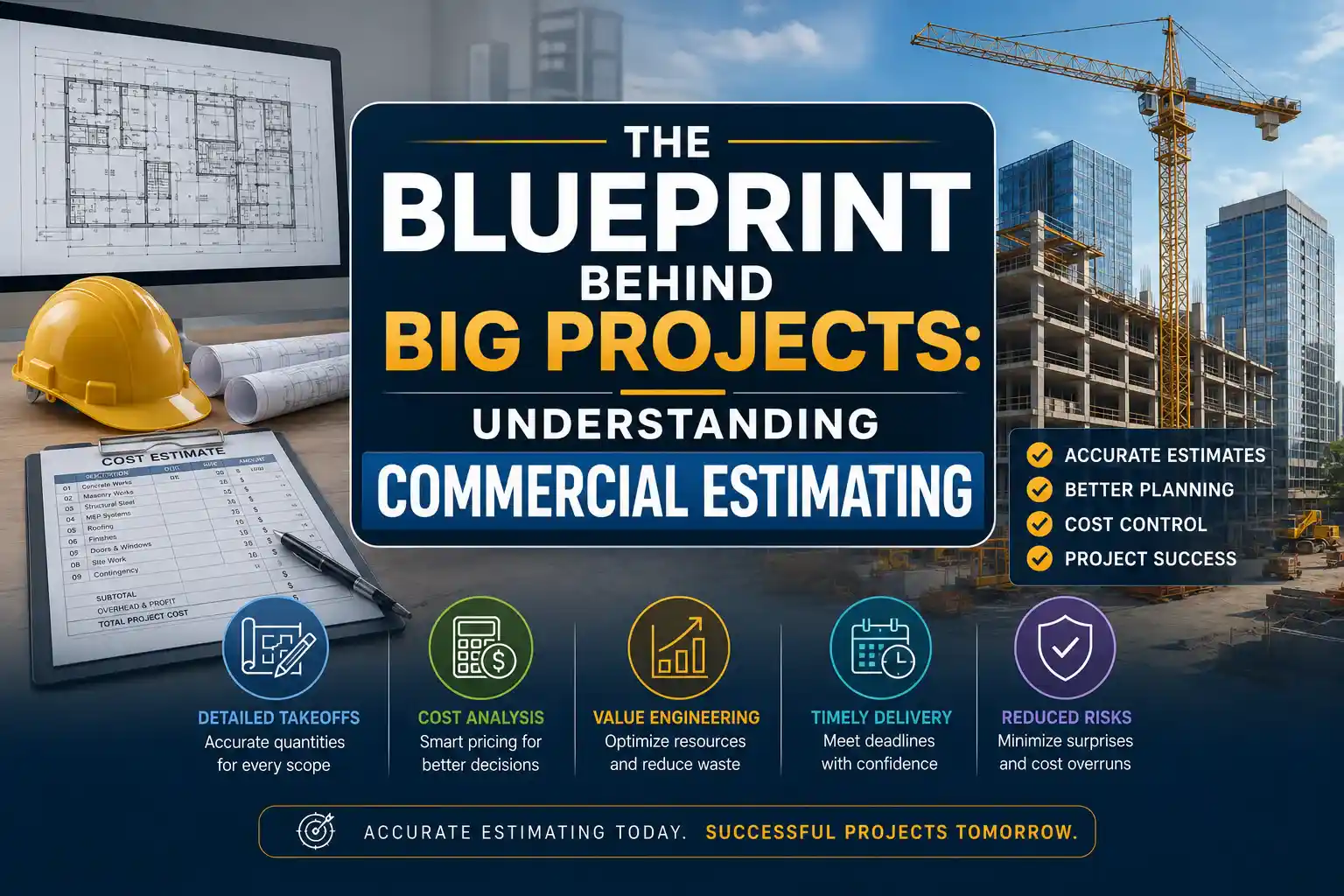

Large and complex construction projects do not start with bricks, steel or concrete. Every successful construction project starts with an accurate cost estimation plan. Cost estimation helps estimators, contractors and project managers understand how much money, work and materials are needed before the project work begins.
Commercial estimating plays a major role for offices, schools, shops, hospitals, hotels, warehouses, factories and many other buildings because it helps plan costs properly. A strong cost estimate works like a clear blueprint for a project’s costs. Understanding cost estimating properly helps in making smart decisions from the first stage of the project.
What Is Commercial Estimating?
Commercial estimating means calculating the total cost of commercial construction projects. Cost estimators check drawings, plans, labour rates, equipment costs and material costs to make accurate cost estimates. Commercial estimates include:
- Material cost
- Labour cost
- Equipment cost
- Plumbing costs
- Finishing costs
- Site preparation costs
- Mechanical and electrical work
- Overhead and profit
Commercial construction projects are usually very large and complicated. Small calculation mistakes cause big money problems later. Good estimates help construction companies avoid waste, extra costs and delays.
Types of Commercial Construction Estimates
Commercial construction estimates have different types which are listed below.
- Preliminary Estimate
This type of estimate gives project owners rough cost idea at the beginning of planning so that they can decide if the project is financially possible or not.
- Detailed Estimate
This kind of estimate provides exact calculations for labour, materials, equipment and the different phases of the project.
- Bid Estimate
Bid estimates are made when contractors are preparing for commercial projects. This estimate has to be competitive so the contractor wins the bid without bidding too low or losing their profit.
- Change Order Estimate
Estimators prepare change order estimates when changes in project plans happen during construction. In this type, the estimators calculate additional costs or savings.
Main Steps in Commercial Estimating
The steps involved in commercial estimating are given below.
Step 1. Understand Project Scope
Estimators carefully study drawings and technical project specifications so they understand the size, design and scope of the project clearly.
Step 2. Do Quantity Takeoffs
Quantity takeoff is about measuring all the materials needed for the project. Estimators calculate how much concrete, steel, drywall, flooring, roofing and all the other materials that are needed for the project.
Step 3. Estimate Labour Costs
The cost of labour depends on project size, need for skilled workers and the time the construction project will take.
Step 4. Add Material and Equipment Costs
Material prices go up and down quickly because of market conditions. Estimators use current prices for building materials, tools, machinery and rental equipment.
Step 5. Add Overhead and Profit in Final Estimate
Estimators include overhead costs such as business expenses, insurance and transportation along with profit margins in the final estimate.
Benefits of Commercial Estimating
The benefits of commercial estimating are given below.
Improved Project Scheduling
Good estimates help contractors plan materials, equipment and labour in a better way. Good planning stops delays and keeps work done on time.
Stronger Bidding Process
Construction companies use estimates for submitting project bids in a simple and clear way. A correct estimate increases the chance of getting a good contract without giving a very low bid.
More Effective Budgeting
Project owners need clear financial figures at the start of construction work. Many builders hire trusted Commercial Estimating Services to develop accurate budgets in detail to avoid over-budgeting. These services give businesses a clear estimate of the total project cost and reduce unexpected expenses in the future.
Lower Financial Risks
Unexpected expenses damage the project adversely. Commercial estimation is useful to find possible risks so the team can prepare better solutions.
Build Investor Trust and Confidence
Commercial estimating keeps construction projects on track from start to finish. A detailed estimate helps owners feel confident before investing a large amount of money.
Skills Needed for Commercial Estimating
Successful commercial estimators need technical knowledge and problem-solving skills. Important skills needed for commercial estimating are listed below.
- Strong math abilities
- Attention to detail
- Knowledge of construction materials
- Understanding of blueprints
- Time management
- Cost analysis skills
- Communication skills
Experienced and skilled estimators can identify hidden costs, predict risks and create more accurate project budgets.
Challenges in Commercial Estimating
Commercial estimating is not always simple. It involves major challenges which are given below.
- Sudden Change in Material Prices: Material prices go up fast because of supply chain issues or market demand. So estimators must use updated prices all the time.
- Incomplete Project Information: Sometimes, projects start before all drawings are complete. This missing information makes estimating more difficult.
- Pressure due to Tight Deadlines: Many contractors have to submit their bids quickly. Short deadlines increase pressure on estimators to work fast and still be accurate.
- Complex Building Systems: Commercial buildings include complicated electrical, plumbing, HVAC and safety systems. Commercial estimating has to deal with building systems. Contractors and builders hire Industrial Estimating Services because these projects have highly specialized equipment and complex construction requirements. These services provide professional estimators who help with complex building systems while avoiding budget overruns.
How Accurate Estimating Supports Project Success
A commercial estimate has a direct impact on the success of the construction project. Understanding commercial estimating helps contractors maintain their profit and finish good-quality work on time. Clear financial planning causes fewer surprises during construction and improves project management.
Large commercial projects need strong coordination between teams to work together. Estimating creates a financial road map for better and smarter decisions during the entire project.
Final Thoughts
Commercial estimating is the financial backbone of all major construction projects. Many contractors and developers choose the Best Estimating Company to improve bid accuracy, control project costs and complete construction projects in an efficient way so their projects run smoothly without extra costs or delays. Good estimates handle risks, control budgets, plan well and make smart decisions.
All offices, shops, warehouses, hospitals and other commercial buildings need careful planning and detailed cost analysis. Strong commercial estimating makes construction ideas successful real projects for business owners while keeping budgets and timelines under control.